

Measuring the internal diameter of a ring using a vernier gauge
Getting the right size for a ring or bangle can feel intimidating, especially if you “hate maths”. I have had so many students tell me that they find the numbers too intimidating and fear of getting it wrong is what puts them off making their own jewellery.
But the secret is actually that the maths behind ring and bangle sizing is actually very simple. With a couple of easy measurements and one straightforward formula, you will be able to size accurately without any fear of mistakes.
In this guide I will walk you through that formula step by step so you can use it quickly and accurately whenever you need to.
If you are a Cognac Jewellery School Member, you also have access to a Ring & Bangle Sizing Calculator that does the numbers for you in a few seconds, so you can double check your measurements and feel completely confident before you cut into your metal.
In this guide, we’ll cover:
The formula jewellers use to work out ring and bangle lengths
How to use the Cognac Jewellery School Ring & Bangle Sizing Calculator to get instant wire lengths
The Basics: Key Ring and Bangle Sizing Terms
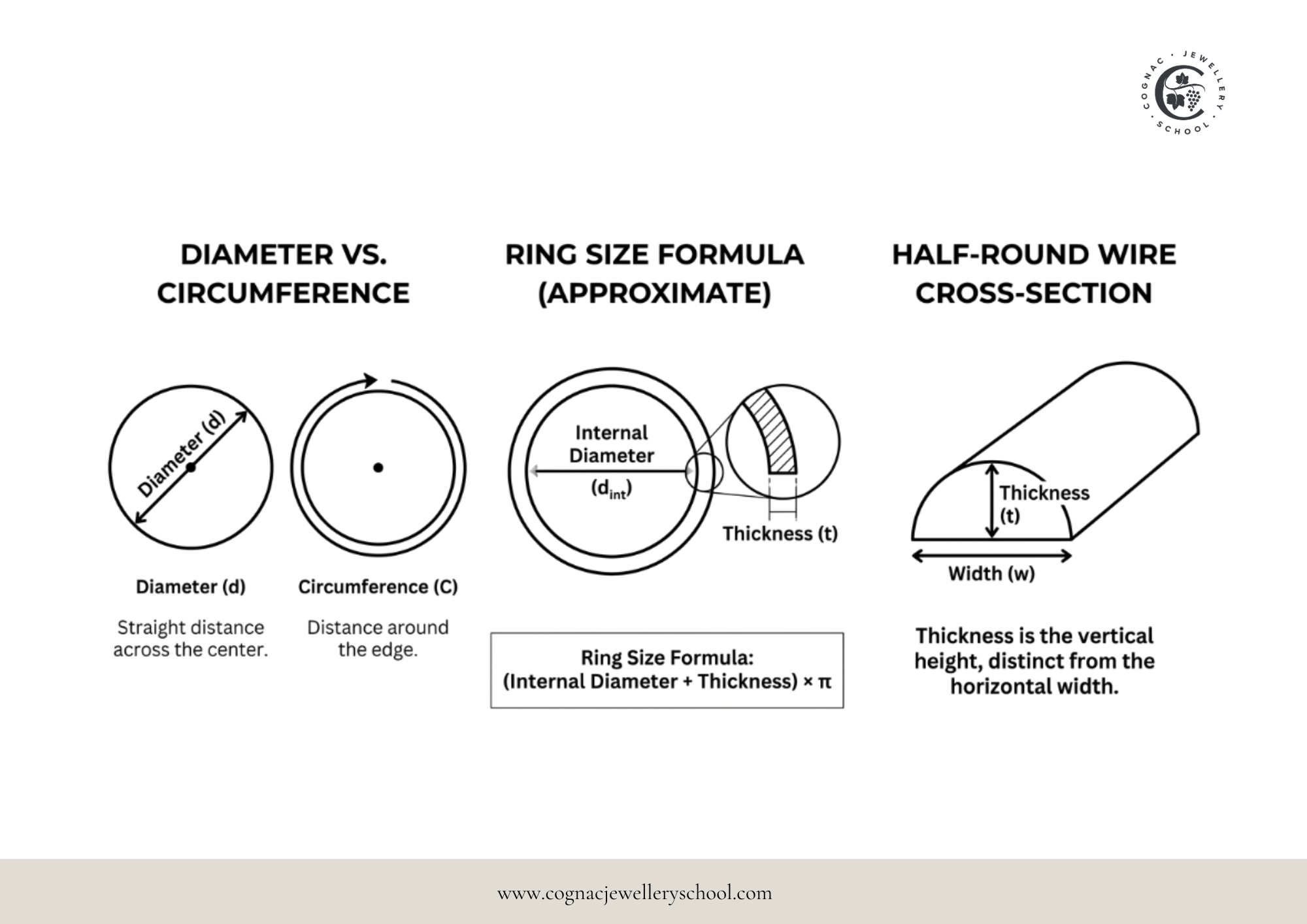
Internal Diameter
The distance across the inside of a ring or bangle; a straight line passing from one side to the other through the centre point of the circle (measured in millimetres).
Circumference
The distance all the way around the outside edge of the ring or bangle.
Thickness of Wire or Metal
How deep your metal is from inside to outside. For example, 1.5mm round wire or 2mm thick sheet.
π (Pi)
A mathematical constant we use to calculate ring and bangle sizes.
π = 3.14
These are the only ingredients you need to size rings and bangles with confidence.
How To Measure Your Ring Size Accurately

An example of a boxed ring sizing set with a ring sizing mandrel (triboulet)
The most accurate way to measure your ring size (or someone else’s) is to use:
A ring sizer (set of sample rings)
A ring mandrel (tapered sizing stick)
How to use a Ring Sizer
Try different sizes on the finger you are measuring.
Slide the ring over the joint of the finger.
Aim for:
- Light to moderate resistance over the knuckle
- A ring that feels secure, but not so tight you cannot turn it on your finger
A perfectly sized ring is not about millimetre-perfect precision. It is about comfort and wearability.
How to use a Ring Mandrel
If you (or a customer) already have a ring that fits well:
Slide the ring down the mandrel.
Note the size where it naturally sits.
This gives you a quick, reliable reading without needing to try on all the different ring sizes.
If you do not have these tools yet, you can still measure your ring size with everyday household items. Please watch the video below to find out how
The Standard Ring Sizing Formula for Jewellery Makers
When you are making a ring from wire or sheet, you need to know how long to cut your metal so that the finished ring fits the intended size.
For a standard ring, jewellers use this formula:
(Internal diameter+thickness of the metal)×π
Using π as 3.14, that becomes:
(Internal diameter+metal thickness)×3.14
This allows for the thickness of the metal so that the inside of the finished ring matches the size you want.
Example: Size 52 / UK M / US 6
Let us say you want to make a European size 52 ring (UK M, US 6) using 1.5 mm thick wire.
Internal diameter for size 52 = 16.7 mm
Wire thickness = 1.5 mm
Add them together:
16.7 mm+1.5 mm=18.2 mm
Multiply by π (3.14):
18.2×3.14=57.17 mm
That is it. You now have the correct length of wire to make your ring.
How To Measure Your Bangle Size
Now that you have seen how ring sizing works, you can use exactly the same method for bangles. Round bangles use the same simple formula and the same calculator to find your wire length.
There are two easy ways to measure your bangle size:
How to Measure an Existing Bangle
If you already have a bangle that fits perfectly:
Measure straight across the inside from one side to the other, either using a vernier gauge or by laying it flat across a ruler. This will give you the internal diameter.
Then use the formula:
(Internal diameter + thickness of the metal) ×3.14

An example of a bangle sizer
How to use a Bangle Sizer
If you have a bangle sizer (a set of sample bangles in different sizes):
Try different sizes over the widest part of the hand, as if you are putting on a finished bangle.
Aim for a size that:
- Slides over the hand without forcing or pain
- Does not feel like it will fall off when the hand relaxes
Once you have found a comfortable size, note the size marking on the bangle sizer.
Measure the internal diameter of that sizer bangle using your vernier gauge, then use the same formula to find your wire length.
The useful thing is that rings and bangles both use this same simple equation, so once you understand it you can size almost any round piece of jewellery with confidence.
Wide Rings: Why They Often Feel Smaller
If your ring design is wider than about 4mm, it will usually feel tighter than a narrow band in the same size.
Wide bands cover more of the finger, so they need a little extra room to feel comfortable.
For wide rings, it is often a good idea to go half a size to one full size larger.
For very wide statement bands, you may need to go up one to two sizes.
If you are unsure:
Make a paper or base metal mock up first.
Test the fit on the actual finger.
Adjust your size (or calculator inputs) before you cut into precious metal.
This is especially important if you are selling your jewellery or working with custom orders.
Final Tips for Comfortable Ring and Bangle Sizing
A few simple habits will make your sizing more reliable and more comfortable for the person wearing the jewellery.
Measure at the end of the day where possible
Our hands are usually a little larger in the evening, so this gives a more realistic everyday fit.Avoid measuring when you are very cold or very hot
Temperature can make fingers and hands temporarily swell or shrink, which can throw your sizing off.Think about personal preference
If you are between sizes, consider how you (or your customer) like to wear jewellery:- Go up a size for a looser, easy fit.
- Stay true to size (or test with a mock up) for a snug, secure feel.
For rings
The ring should slide over the knuckle with light to moderate resistance, then feel secure once it is in place.For bangles
Make sure the bangle can pass comfortably over the widest part of the hand, but that it does not feel like it will slip off when you relax your hand or fly off if you make any sudden movements!
Taking a little extra time at this stage saves frustration later and helps your finished pieces feel effortlessly wearable, not just beautiful to look at.

Ready to make some rings and bangles? Click here for all the step-by-step online jewellery projects (featured here: The Skinny Stacking Rings, The Trio of Classic Bangles, and the Anticlastic Bangle)
Try the Cognac Jewellery School Ring & Bangle Sizing Calculator
If you are a Cognac Jewellery School member, you do not have to do any of this by hand. If you would like to skip the maths and go straight to making, the Ring & Bangle Sizing Calculator is available inside the Cognac Jewellery School Membership.
It’s perfect for beginners who want the reassurance of accurate measurements as well as experienced makers who simply want to speed up their workflow
You bring the measurements, and the calculator gives you the wire length in seconds. That way you can get back to the fun part: creating beautiful, wearable jewellery, knowing your sizes are accurate and consistent every time.
Calculator example:
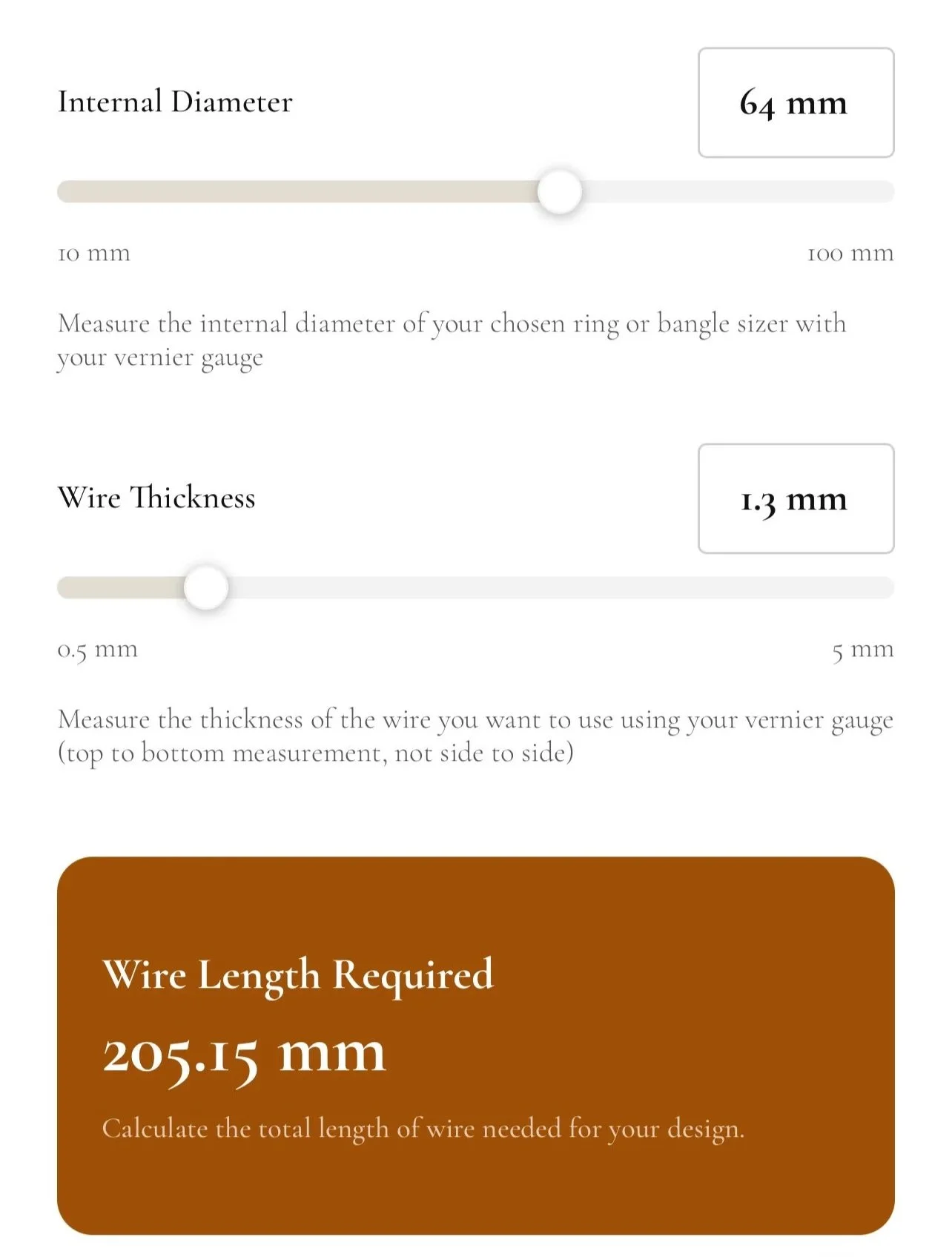
How to use the Ring and Bangle Calculator
Simply type in the internal diameter of your ring or bangle and the thickness of your wire or sheet and the calculator instantly gives you the exact length of wire to cut.
No more second guessing, no more scribbled notes or half remembered formulas. Just easy, accurate measurements every time.